

『Insertion Ultrasonic Flow Meter: Transit-Time Hot-Tap Instrument Positioning and Spacing Guidelines』Related information(v cone flow meter|rotary gas meter|gallon meter|gear meter|metal tube rotameter|glass tube rotameter|nutating disk meter|transit time ultrasonic flow meter|wedge flow meter|pd meters|hydraulic flow meter|ultrasonic water flow meter|water flow meter|air flow meter|magnetic water flow meter|oxygen flow meter|gas flow meter|argon flow meter|air velocity meter|gasoline flow meter|fuel flow meter|ultrasonic water meter|digital water meter|nitrogen flow meter|solid flow meter|Oxygen tank flow meter|digital water flow meter|diesel fuel flow meter|steam flow meter|02 flow meter|compressed air flow meter|oil flow meter|liquid flow meter)
Insertion Ultrasonic Flow Meter: Transit-Time Hot-Tap Instrument Positioning and Spacing Guidelines
Quick Answer: Install a transit-time hot-tap insertion ultrasonic flow meter with at least 10D straight run upstream and 5D downstream for clean liquids. Increase to 20D upstream after pumps, control valves, or two elbows out of plane. Insert the sensor tip to the pipe centerline or the depth calculated for your exact inside diameter.
Why Bad Positions Look Stable but Read Wrong
Most installation errors do not trigger a fault alarm. The transmitter shows a smooth flow value. The value looks normal on the SCADA screen. But the actual error can be 3 to 10 percent. Silver Instruments has checked this on customer sites in Vietnam, Egypt, and Peru. A water treatment plant in Hanoi had a meter installed 4D after a butterfly valve. The reading was 6.8 percent high compared with a portable clamp-on meter.
Insertion ultrasonic meters use the transit-time principle. Two acoustic signals travel through the liquid. One signal moves with the flow. One signal moves against the flow. The meter measures the time difference. A distorted velocity profile changes this time difference. The meter cannot know the profile is distorted. That is why position and spacing rules are the first thing to check.
Straight Run Requirements for Insertion Hot-Tap Meters
The straight run is measured in pipe diameters D. D means the internal diameter, not the nominal DN. For a DN200 line with an actual inside diameter of 192 mm, 10D means 1920 mm of straight pipe. The same rule applies to small lines from DN15 up to large DN2000 pipes. For most water, wastewater, gas, and light chemical lines, use at least 10D upstream and 5D downstream. After a pump discharge, a control valve, or two 90 degree bends in different planes, use 20D upstream. Keep the downstream run at 5D minimum.
Some installers ask for a shorter run. If you have no space, install a flow conditioner. A properly sized flow conditioner can reduce the upstream requirement to 8D. The flow conditioner must match the pipe schedule and the liquid viscosity range. Silver Instruments does not recommend a flow conditioner as the first choice because it adds pressure drop and cost.
Sensor Tip Depth and Insertion Angle
The transducer tip should sit in the high velocity core of the pipe. For a single path insertion meter, set the tip at the pipe centerline. For a dual chord meter, the two positions are often 1/8 and 7/8 of the actual inside diameter. The depth is measured from the outside pipe wall to the transducer face. Do not set the depth by guessing from the valve body length. Use the insertion tool scale and mark the pipe wall thickness. A 10 mm depth error on a 150 mm line moves the sensor out of the core. A caustic soda line at a chemical plant in Thailand read 14 percent low for this reason.
After the probe reaches the target depth, check the transducer face angle. The face must be parallel to the pipe axis. If the probe is rotated a few degrees, the acoustic path length changes. The signal strength drops. The transmitter may still hold the last reading or show a low signal alarm. Most engineers skip this part. The probe body has a mark for alignment.
Spacing Between Two Hot-Tap Probes
Some transit-time insertion meters use two separate insertion probes on opposite sides of the pipe. The axial spacing between these probes is not a random distance. It depends on the acoustic path angle and the actual inside diameter. Common path angles are 30, 45, and 60 degrees. A DN80 pipe with a 45 degree path needs a different spacing than a DN80 pipe with a 60 degree path. Use an ultrasonic thickness gauge to measure the real wall thickness. Nominal DN is not enough. A 1 mm wall thickness error changes the path length and the zero offset.
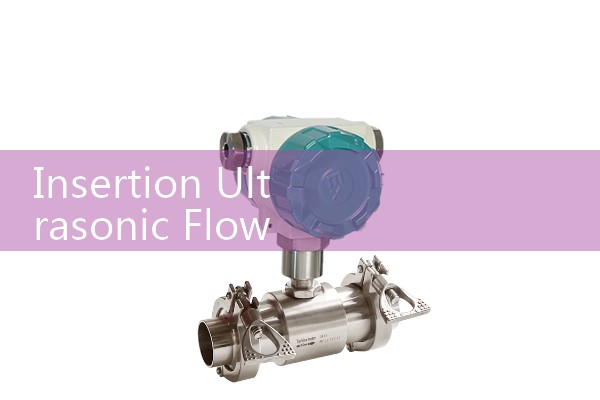
For a single probe with a reflector or a single probe that sends and receives through the same port, the spacing rule is simpler. The insertion depth and the straight run matter more than probe to probe spacing. Silver Instruments can calculate the depth and any spacing for your pipe schedule and pressure rating.
Hot-Tap Installation Steps and Pressure Limits
Hot-tap installation allows a meter to be installed without draining the line. Use a ball valve and insertion mechanism rated for the line pressure and temperature. For a steam line or a high pressure gas line, verify the hot-tap gear pressure class. For an ATEX Zone 1 area, confirm the transmitter housing and the insertion mechanism carry the correct certificate. The 4-20 mA HART output can be wired to the PLC or flow computer after the transducer is inserted.
During insertion, open the ball valve. Push the probe through the valve. Record the insertion depth. Tighten the compression fitting. Then rotate the probe to the alignment mark. Connect the transmitter. Check the signal strength. A healthy signal is usually above 30 percent on a Silver Instruments transmitter. If the signal is low, move the probe depth by 5 mm and observe the result.
Application Examples from Customer Sites
In a desalination plant near Muscat, Oman, an insertion ultrasonic meter was placed 15D after a 90 degree elbow on a reverse osmosis feed line. The meter agreed with a Coriolis reference meter within 0.8 percent across a flow range from 80 to 260 cubic meters per hour. The pipe was DN300. The liquid was seawater with a conductivity above 50,000 µS/cm. The meter used a duplex stainless steel probe.
In a food oil blending line in Malaysia, a meter was installed too close to a gear pump. The flow reading bounced. The customer moved the meter to a 14D straight section and the output stabilised. The line ran at 42 degrees Celsius with a viscosity near 30 cP. A PT100 temperature input allowed the transmitter to correct the sound speed for the oil blend.
Submit a Layout Sketch and Operating Data
Before you hot tap, send Silver Automation Instruments the pipe inside diameter, wall thickness, straight run lengths, liquid type, pressure in bar, temperature in °C, and flow range. We will reply with a sensor depth table and a spacing calculation for your DN. For urgent site support, call Tel: +86-25-68650347. For quick layout checks, use WhatsApp: +86-25-52155837 or WeChat: +86 15365082610.
FAQ: Five Questions Engineers Ask Before Hot-Tap Installation
How much straight run does a hot-tap insertion ultrasonic meter need?
Use at least 10D upstream and 5D downstream for clean liquids. Use 20D upstream after pumps, control valves, or two elbows out of plane.
How deep should the transducer be inserted?
Usually the tip goes to the pipe centerline for single path meters. For dual chord meters, position the probes at 1/8 and 7/8 of the actual inside diameter.
Can I install an insertion meter under pressure?
Yes. Use a hot-tap ball valve and insertion mechanism rated for the line pressure and temperature. Follow your site permit for hot work and pressure. Never remove the valve while the pipe is pressurised.
How do I calculate the spacing between two insertion probes?
The spacing is set by the actual inside diameter and the acoustic path angle. Measure the real wall thickness. Do not use nominal DN. Silver Instruments can calculate the spacing from your pipe schedule and pressure rating.
What is the most common positioning mistake?
Installing the sensor too close to an elbow or valve. The meter still outputs a value. The value looks stable. But the accuracy can be off by several percent. A quick straight run check before hot tapping prevents this.
 Hot Blog
 Related AD